Wednesday, October 28, 2026
Wednesday, October 28, 2026
* All product/brand names, logos, and trademarks are property of their respective owners.
Artificial intelligence is changing the way people work, learn, and apply for jobs. Candidates can now use AI tools to improve their resumes, prepare interview answers, and complete online assessments. Although these tools can support learning and productivity, they can also make it difficult for employers to determine whether a candidate has the skills required for a role.
For recruiters, the challenge is no longer limited to reviewing resumes and conducting interviews. They must also verify whether candidates can solve problems, think independently, and perform job-related tasks without relying excessively on outside assistance. When an assessment does not reflect a candidate’s actual abilities, hiring decisions can become less reliable.
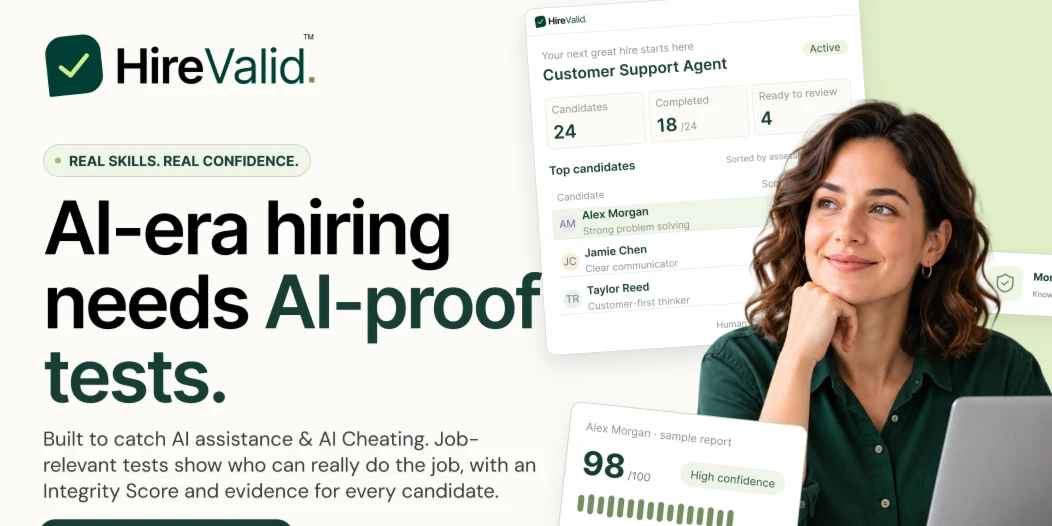
HireValid helps employers evaluate candidates through skills-based and cognitive assessments designed to identify genuine ability and highlight potentially unusual assessment behavior. By combining assessment results with integrity signals, employers can make more informed decisions while keeping human judgment at the center of the hiring process.
Traditional hiring assessments were designed to measure a candidate’s knowledge, reasoning, and problem-solving abilities. However, the growing availability of AI tools has changed how some candidates approach these tests. A candidate may use an AI assistant to generate answers, explain technical concepts, or complete tasks that they would otherwise need to solve independently.
This creates a gap between a candidate’s assessment performance and their actual workplace abilities. Someone may achieve a strong score during a test but struggle to complete similar tasks after joining the organization. As a result, recruiters may overlook qualified applicants or select candidates whose skills have not been adequately verified.
The problem also affects fairness. Candidates who complete assessments independently may be evaluated alongside people who receive outside assistance. When the same rules are not followed by everyone, assessment results become harder to compare.
An effective Anti AI Cheating approach focuses on evaluating genuine skills rather than relying on test scores alone. Employers need meaningful assessment results, clear evidence, and appropriate review procedures to understand how candidates performed.
Employers can improve hiring accuracy by using assessments that measure the abilities required for a particular role. Instead of depending only on resumes, qualifications, or self-reported experience, recruiters can ask candidates to demonstrate their knowledge and reasoning.
For example, a technical candidate may complete a practical coding task, while a customer service applicant may respond to realistic workplace situations. A reasoning assessment can help employers understand how candidates analyze information, recognize patterns, and approach unfamiliar problems.
Several assessment methods can support this process:
Cognitive assessments: These measure reasoning, problem-solving, and the ability to understand information.
Technical assessments: These evaluate job-related technical knowledge and practical skills.
Language assessments: These help employers evaluate written communication and language proficiency.
Situational judgment tests: These present workplace scenarios and assess how candidates respond.
Practical skills tests: These allow candidates to demonstrate abilities through tasks that reflect real job responsibilities.
When assessments match the requirements of a position, employers gain a clearer picture of each candidate’s strengths. However, no single test can provide a complete understanding of a person’s potential. Recruiters should consider assessment scores alongside interviews, experience, qualifications, and other relevant evidence.
An AI-resistant hiring assessment is designed to make it more difficult for candidates to rely on unauthorized assistance while completing a test. It combines suitable assessment formats with controls and integrity signals that help employers review candidate behavior.
For example, randomized question pools can reduce the likelihood that every candidate receives the same questions. Timed reasoning tasks can encourage candidates to work within a defined period, while visual and interactive activities can help assess practical thinking. Explain-your-answer prompts can also provide additional insight into how a candidate concluded.
Other controls may include restricted copy-and-paste functionality, optional full-screen mode, and single-use invitation links that expire after a set period. Depending on the assessment setup, employers may also receive information about tab switches, paste events, unusual answer timing, or similarities between responses.
These measures can support a more reliable assessment process, but they should not be treated as absolute proof of misconduct. A browser event or an unusual response pattern may have a legitimate explanation. Employers should review the available evidence before drawing conclusions about a candidate.
HireValid helps employers assess candidate skills and review integrity signals during the hiring process. Its assessment approach combines performance results with information that can help recruiters identify behavior requiring further attention.
The platform provides an Integrity Score on a scale of 0 to 100, along with supporting evidence and a timeline of relevant signals. This information helps recruiters understand the assessment context instead of relying only on a single score.
Depending on the assessment and its configuration, relevant signals may include unusual response timing, tab switches, paste events, and similarities between candidate answers. Optional webcam snapshots may also be available with explicit consent. These signals provide context for review, but they do not automatically establish that a candidate used AI inappropriately.
HireValid is designed to support human decision-making, not replace it. Recruiters remain responsible for evaluating the evidence, considering reasonable explanations, and deciding whether additional verification is necessary. This approach helps employers balance assessment integrity with fairness toward candidates.
For organizations looking for an Anti AI Cheating Solution, HireValid offers a practical way to combine skills assessment with integrity monitoring. Its purpose is to help employers make better-informed hiring decisions while reducing their dependence on assessment scores alone.
Employers should choose assessment platforms that evaluate job-related skills, ensure fair testing, and provide clear results.
1. Job-Related Assessments: Tests should match the skills and responsibilities required for the role.
2. Multiple Assessment Formats: Cognitive tests, practical tasks, language tests, and situational judgment exercises help evaluate different abilities.
3. Integrity Signals: Monitoring features can highlight unusual activity for further review, but they should not be treated as proof of misconduct.
4. Transparent Results: Clear scores and supporting evidence help recruiters compare candidates consistently.
5. Fair Candidate Experience: Clear instructions, visible timers, autosave, and reasonable accommodations help create a better assessment experience.
HireValid combines skills assessments and integrity monitoring to help employers make informed hiring decisions with a practical anti-AI cheating solution.
Businesses can make hiring fairer by setting clear assessment rules and applying them consistently. Recruiters should review assessment scores and integrity signals carefully, as unusual activity does not always indicate misconduct.
Combining skills assessments, structured interviews, and follow-up tasks helps verify candidates’ abilities. Employers should also protect candidate privacy, consider accessibility, and communicate monitoring policies clearly.
AI tools have created new challenges for recruitment, but employers can respond by improving how they assess and verify candidate skills. Job-related tests, practical tasks, integrity signals, and structured human review can help organizations understand candidate performance more clearly.
HireValid supports this process by combining skills and cognitive assessments with integrity information that recruiters can review. Its features help employers identify unusual activity, examine supporting evidence, and make decisions with greater context. However, final hiring decisions should always consider the candidate’s overall qualifications and the evidence available.
For businesses that want to evaluate genuine skills and strengthen assessment integrity, choosing the right Anti AI Cheating Solution can be an important step toward smarter, fairer, and more reliable hiring.
AI cheating in recruitment refers to the unauthorized use of AI tools to complete an assessment or produce answers that do not accurately reflect a candidate’s independent abilities. Employers should define permitted and prohibited assistance before testing begins.
Employers can use job-related assessments and review relevant integrity signals, such as unusual response timing, paste events, or tab switches. These signals should be evaluated in context because no single indicator proves that a candidate used unauthorized assistance.
No assessment can guarantee that all AI assistance will be prevented or detected. Multiple assessment methods and appropriate integrity controls can make unauthorized assistance more difficult and provide useful information for human review.
An Anti AI Cheating Solution helps employers evaluate candidate skills and identify assessment behavior that may require further review. It can combine assessment design, monitoring signals, and supporting evidence to help recruiters make more informed decisions.
Skills-based hiring focuses on a candidate’s demonstrated abilities rather than relying only on qualifications or work history. It helps employers assess whether applicants can perform tasks relevant to the role and supports more evidence-based hiring decisions.
HireValid provides skills and cognitive assessments alongside integrity signals and an Integrity Score. These tools help recruiters review candidate performance and investigate unusual assessment behavior while keeping final hiring decisions under human control.

Most architecture dissertations don't collapse because the writing is weak. They collapse because th
12 September 2026
The World Tech Olympiad gives school students an opportunity to explore technology, test their knowl
20 August 2026
Here is a metric that should haunt every product leader, business analyst, and enterprise executive:
29 July 2026
Be the first to share your thoughts
No comments yet. Be the first to comment!
Share your thoughts and join the discussion below.