Wednesday, October 28, 2026
Wednesday, October 28, 2026
* All product/brand names, logos, and trademarks are property of their respective owners.
Artificial intelligence is becoming an important part of how businesses process information, understand human language, and analyze visual data. From chatbots that answer customer questions to systems that recognize objects in images, AI applications depend on accurate data to produce reliable results. However, before an AI model can understand patterns and make predictions, it needs data that has been properly organized and labelled.
This is where an AI data annotation platform plays an important role. It helps teams prepare training data by adding meaningful labels, categories, and contextual information to text, images, videos, and other data types. These annotations help machine learning models learn how to interpret information and perform specific tasks.
Two major areas that benefit from this process are Natural Language Processing (NLP) and computer vision. Although both technologies use AI to understand information, they work with different types of data and require different annotation methods.
An AI data annotation platform is a tool or software environment that allows teams to label and organize data for training, testing, and improving machine learning models. Depending on the project, the platform may support text classification, image labelling, video annotation, audio transcription, and other data preparation tasks.
For example, a company developing a customer support chatbot may need thousands of customer messages categorized by intent. Meanwhile, a business building an image recognition system may need images labelled to identify vehicles, people, products, or other objects.
A data annotation platform provides a structured environment for completing these tasks. Many platforms also offer collaboration tools, quality checks, automation features, and workflows that help teams manage large datasets more efficiently.
Natural Language Processing enables computers to analyze, interpret, and work with human language. It is used in applications such as virtual assistants, search engines, sentiment analysis tools, translation systems, and automated customer service solutions.
For NLP models to understand language correctly, they need examples that show how words, phrases, and sentences should be interpreted.
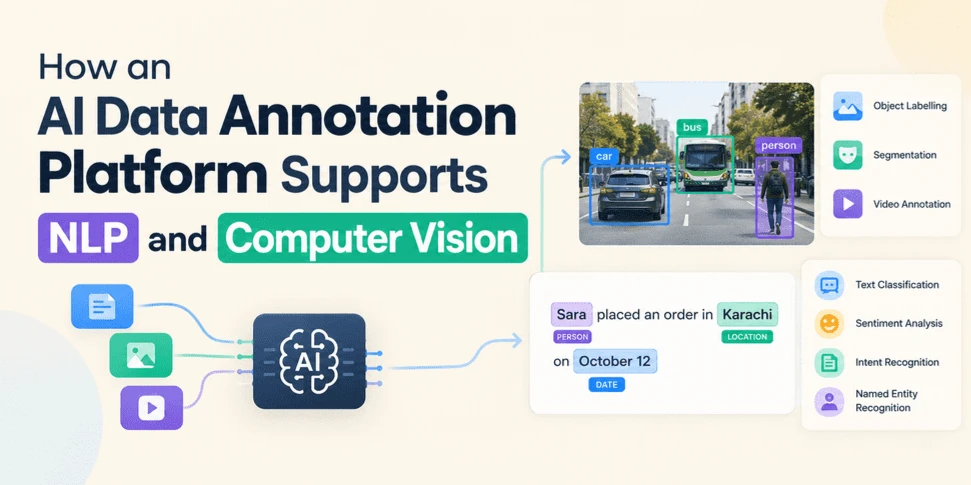
Text classification involves assigning predefined categories to written content. An AI data annotation platform helps teams label text according to its purpose or meaning.
For example, customer messages can be classified into categories such as billing inquiries, technical support, product complaints, or order tracking. These labelled examples help an AI model learn to recognize similar requests in new messages.
Text classification is also useful for filtering spam, organizing documents, and categorizing online reviews.
Sentiment analysis helps AI systems identify opinions and emotional tone in written text. Businesses use it to understand customer feedback, monitor reviews, and analyze public responses to their products or services.
Annotators may label statements as positive, negative, or neutral. More advanced projects can include categories such as frustration, satisfaction, urgency, or disappointment.
For instance, a review stating that a product arrived late and the customer service team was unhelpful may be labelled as negative. A collection of consistently annotated examples helps a model learn to identify similar patterns.
Named Entity Recognition (NER) is an NLP technique that identifies important information within text, including names, locations, dates, organizations, and monetary values.
An annotation platform allows teams to mark these entities within sentences. For example, in the sentence “Sara placed an order in Karachi on October 12,” the name, location, and date can each receive a different label.
This process supports information extraction, document processing, recruitment tools, and systems that organize large volumes of business information.
AI assistants and chatbots must understand what a user wants before they can provide an appropriate response.
An annotation team can label messages according to user intent, such as requesting a refund, checking delivery status, or asking about product availability. These examples help NLP models connect different ways of expressing the same request with the correct action.
Accurate intent annotation can improve chatbot responses and reduce the need for human intervention in routine customer service interactions.
Computer vision allows AI systems to interpret visual information, including photographs, scanned documents, and video footage. It is widely used in manufacturing, retail, healthcare research, transportation, agriculture, and security applications.
Unlike NLP, which focuses primarily on language, computer vision relies on visual patterns. Annotation provides the labels that help models learn which objects, shapes, boundaries, or activities appear in visual data.
Image classification involves assigning a category to an entire image. An annotation platform helps teams organize images into relevant classes for model training.
For example, an e-commerce business may classify product images such as shirts, trousers, shoes, and accessories. An agricultural project might categorize images according to visible plant conditions.
These labelled datasets help models learn to distinguish between different types of images.
Object labelling is an important part of preparing visual data for computer vision applications. It involves identifying objects within images or videos and assigning them meaningful labels.
For object detection, annotators commonly draw bounding boxes around visible objects and attach the appropriate category. A traffic monitoring dataset, for example, may contain separate labels for cars, buses, bicycles, and pedestrians.
This process teaches AI models not only what an object looks like but also where it appears within an image.
Accurate object labelling is particularly important in autonomous driving research, inventory monitoring, robotics, and visual inspection systems. If objects are labelled inconsistently, a model may struggle to recognize them correctly in unfamiliar images.
Image segmentation takes visual annotation a step further by identifying the specific pixels that belong to an object or region.
Instead of drawing a simple rectangle around a vehicle, an annotator may outline its exact visible shape. This level of detail can be useful when an AI system needs to distinguish an object from its background.
Semantic segmentation assigns pixels to categories, while instance segmentation distinguishes between individual objects of the same category.
These methods support applications such as road-scene analysis, industrial defect detection, and image-based scientific research.
Video annotation involves labelling objects, movements, or activities across a sequence of frames. An AI data annotation platform can help teams associate the same object across multiple frames and maintain consistent labels over time.
For example, a retail analytics project may track products moving along a conveyor belt, while a transportation project may analyze the movement of vehicles through an intersection.
Video annotation helps prepare datasets for activity recognition, motion analysis, and object-tracking models.
Preparing high-quality datasets requires more than adding labels manually. Projects often involve large volumes of data, multiple annotators, detailed instructions, and repeated quality checks.
Although annotation is essential to AI development, it can present several challenges.
One common issue is inconsistent labelling. If different annotators interpret the same instructions differently, the resulting dataset may contain conflicting examples. Clear guidelines and regular quality reviews help reduce this risk.
Another challenge is managing complex or specialized data. Medical images, technical documents, and industry-specific terminology may require subject-matter expertise.
Data privacy is also important. Projects involving customer conversations, personal information, or sensitive images should follow appropriate access controls, data protection requirements, and retention policies.
Finally, annotation quality should be evaluated throughout the project rather than only at the end. Regular sampling, reviewer feedback, and documented quality metrics help teams identify problems before they affect the training process.
The right platform depends on the type of AI model being developed and the complexity of the dataset.
For NLP projects, useful capabilities may include text classification, entity tagging, sentiment labelling, and intent annotation. Computer vision projects may require bounding boxes, polygon annotations, image segmentation, and video tracking.
Organizations should also evaluate collaboration features, quality assurance tools, integration options, data security, scalability, and overall project costs.
It is equally important to consider whether the platform supports human review and provides enough flexibility to accommodate changing project requirements. A platform that works well for a small image classification task may not necessarily meet the needs of a large-scale video annotation project.

The real reason why personalization fails in marketing isn’t that marketers lack ideas. It usu
15 September 2026
The success of any event depends on more than just a great venue and a well-planned schedule. Behind
3 August 2026
If you examine the current professional landscape, you will notice a stark, fascinating division wit
3 July 2026
Be the first to share your thoughts
No comments yet. Be the first to comment!
Share your thoughts and join the discussion below.