Friday, November 20, 2026
Friday, November 20, 2026
* All product/brand names, logos, and trademarks are property of their respective owners.
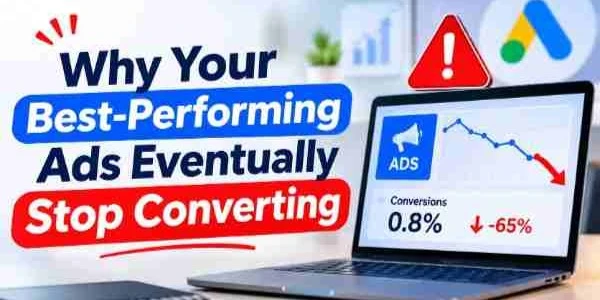
Every advertiser knows the feeling. A new campaign launches, and within days it starts delivering cheap leads, steady sales, and returns that make the whole team smile. You increase the budget, share the results in meetings, and treat the ad as a permanent asset. Then, a few weeks or months later, the numbers slip. Costs rise, clicks fall, and the same ad that once carried the account now struggles to break even.
This pattern is so common that it is almost a rule of paid advertising. A winning ad is not a machine that runs forever. It is more like a fresh loaf of bread: excellent at first, and noticeably worse as time passes. The good news is that the decline is predictable, and once you understand the causes, you can plan for it instead of panicking when it arrives.
This article explains why strong ads lose their power, how to recognize the early warning signs, and what to do about it, with practical steps any business owner can follow. If you want a team to monitor and refresh your campaigns, professional digital marketing services in Karachi can take that work off your hands.
The simplest explanation is repetition. When you show the same ad to the same group of people again and again, they stop noticing it. At first, the message feels fresh and relevant. By the fifth or tenth time, it becomes background noise, and some people begin to find it annoying. Engagement drops, and platforms respond by charging more to show it.
This is especially visible when your target audience is small. A local business advertising to a narrow area, or a campaign aimed at website visitors only, can exhaust its audience quickly. Everyone likely to respond has already responded, and the rest have seen the ad enough to ignore it. The ad did not suddenly become bad. It simply ran out of new people to persuade.
Another reason is less obvious. In the first days of a campaign, advertising platforms look for the people most likely to act, and your ad reaches those eager buyers first. They were already close to purchasing, so your offer felt perfectly timed. This creates a flattering early performance that is partly luck and partly the pool of ready customers.
As the campaign continues and the budget grows, the platform has to reach people further from the point of buying. These people need more convincing, so conversion rates fall, and the cost of each sale rises. The ad has not changed, but the audience has become harder to win. Understanding this helps you avoid the mistake of judging an ad by its first week and then expecting the same results at higher spending.
Ads also age because the world around them changes. Trends shift, competitors copy what works, and styles that felt new a few months ago begin to look familiar. A video format that stood out in the feed last quarter may now blend in with dozens of similar ones. A discount that felt exciting becomes normal once customers expect it.
Seasonality plays a part as well. An offer that suited a festive period or the start of a school term may feel out of place a few weeks later. Even small details, such as visuals, headlines, and the first few seconds of a video, can lose their pull when viewers have seen similar ideas many times. If your ad looks like everything else, it will perform like everything else.
Advertising is an auction, so your results depend partly on what others are doing. When a competitor increases their budget or launches a strong offer, the cost of reaching your audience can rise even if your ad stays exactly the same. Busy periods bring more advertisers into the same space and push prices up.
This means a falling return is not always a sign that your ad is broken. Sometimes the market simply became more expensive. The skill is in separating the two. If your engagement is steady but costs have climbed, competition may be the cause. If engagement itself is falling, fatigue or stale creative is more likely. Looking at both sides prevents you from fixing the wrong problem.
Many people blame the ad when the real issue lies elsewhere. An ad can attract plenty of clicks and still fail to convert if the page behind it has a problem. A website that has become slow, a form that stopped working, a price that changed, or an offer that no longer matches the promise in the ad can all damage results without any change in the advertising itself.
Check the full journey regularly. Click your own ad on a mobile phone, load the page, and try to complete the action as a customer would. Compare what the ad promises with what the page delivers. Our conversion rate optimization guide explains how to find and fix the weak points on a page, which is often the quickest way to recover performance without touching the ad.
Sometimes the ad is still working, but the numbers say otherwise. Tracking tools can break after a website update, a change in settings, or a new privacy rule that reduces how much data platforms can see. When conversions go unrecorded, the platform believes the ad is failing and may shift spending away from it, which then causes a real decline.
Platforms also change their delivery systems and policies from time to time, which can alter how ads are shown. Before cutting a campaign, confirm that your conversion tracking is firing correctly and that your reported sales match your own records. A quick audit can reveal that the problem is measurement rather than performance.
The decline rarely arrives overnight. Watch for the small signals that appear first. A rising frequency, meaning the average number of times a person has seen your ad, is one of the clearest. A falling click-through rate often follows, then a growing cost per result, and finally lower sales. Comments that turn negative or begin to mention that people keep seeing the same ad are another hint.
Compare performance against your own past results rather than reacting to a single bad day. Short-term swings are normal, so look at trends across a week or two. Set simple alert levels in advance, for example, a cost per lead that rises by a set percentage, so that you act on evidence instead of emotion. The earlier you notice, the cheaper it is to respond.
Relying on a single ad for most of your leads is risky, because any decline hits the whole business. Build several sources of customers so that a weak week in paid advertising does not become a crisis. Search visibility, email, content, referrals, and organic social media all help reduce dependence on one campaign. If you are deciding how much to invest in each, our comparison of SEO vs paid ads explains the strengths and limits of both.
Organic work also makes your ads stronger. People who already recognize your brand from helpful content or good reviews are more likely to respond when an ad appears. Over time, this lowers the cost of every campaign and softens the impact when a particular ad wears out.
An ad that stops converting is not a failure. It is a normal stage in the life of almost every successful campaign. Audiences get tired, early buyers get used up, creative grows stale, costs move, and small technical problems creep in. Your job is not to find one perfect ad, but to build a system that keeps producing good ones.
Check your tracking, watch your frequency and cost trends, test new creative on a regular schedule, and keep adding fresh audiences. Protect yourself by building other sources of customers alongside paid ads. Businesses that treat advertising as an ongoing process rather than a one-time win stay profitable long after the first big success fades.

Large agencies have big advantages: deep benches of specialists, expensive tools, and established re
3 November 2026
Swimming pools are an important feature of hotels, resorts, residential compounds, sports clubs, edu
2 November 2026
Custom Butcher Paper Roll is widely used in food wrapping and packaging. It helps keep food fresh an
28 October 2026
Be the first to share your thoughts
No comments yet. Be the first to comment!
Share your thoughts and join the discussion below.