Friday, November 20, 2026

Friday, November 20, 2026
* All product/brand names, logos, and trademarks are property of their respective owners.
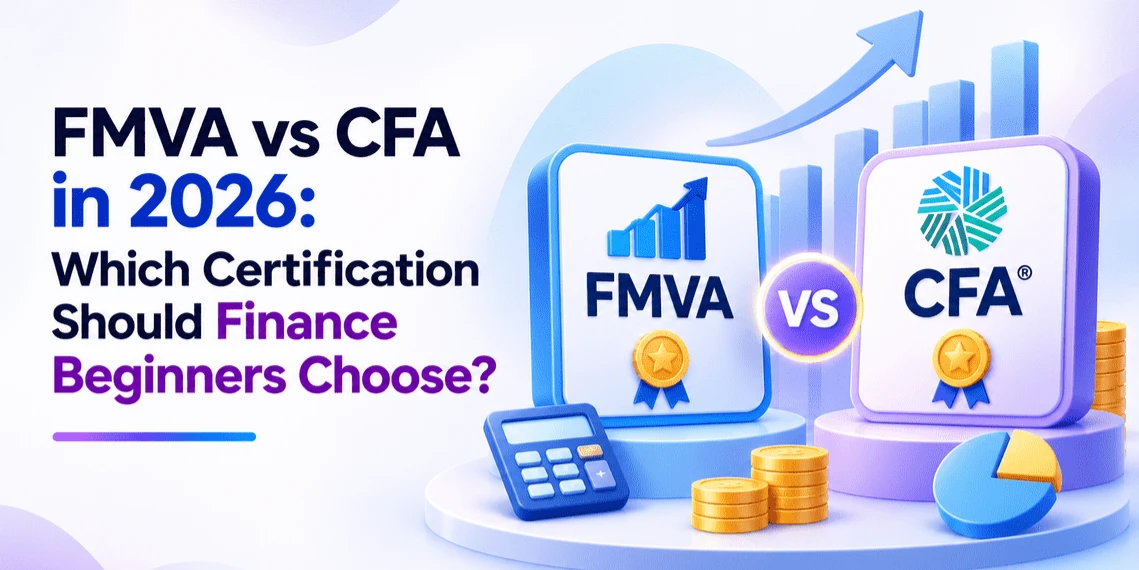
Choosing between the Financial Modeling & Valuation Analyst (FMVA) certification and the Chartered Financial Analyst (CFA) designation depends on the finance career you want to pursue. FMVA is generally better for developing practical financial modeling, Excel, and corporate finance skills, while CFA is better suited to investment analysis, asset management, and portfolio management careers.
Both credentials can strengthen your professional knowledge, but they serve different purposes. One emphasizes technical skills that professionals use in everyday financial analysis. The other provides extensive education in investment principles, financial markets, and professional ethics. Understanding these differences before enrolling can save considerable time, money, and effort.
The Financial Modeling & Valuation Analyst (FMVA) is a professional certification offered by the Corporate Finance Institute (CFI). It focuses on the practical financial skills needed to analyze businesses, prepare financial forecasts, and evaluate investment opportunities. Unlike traditional academic programs, FMVA emphasizes applying financial concepts through spreadsheet-based exercises and realistic business scenarios.
Key skills covered in FMVA include:
Building three-statement financial models.
Creating financial forecasts using Excel.
Performing discounted cash flow (DCF) valuations.
Analyzing financial statements and business performance.
Preparing financial reports and presentations.
Conducting sensitivity and scenario analysis.
According to CFI, the program typically requires approximately 100–120 hours of study, although completion time depends on the learner's experience and pace. The program is delivered online and does not require previous professional finance experience.
For official curriculum details and current enrollment requirements, visit the Corporate Finance Institute's FMVA program.
The Chartered Financial Analyst (CFA) designation is administered by CFA Institute and is widely recognized within the investment management profession. The CFA Program develops a comprehensive understanding of financial markets, investment valuation, risk management, and portfolio construction. It consists of three examination levels, each introducing increasingly advanced investment concepts.
Major subjects covered include:
Financial statement analysis.
Equity and fixed-income investments.
Economics and quantitative methods.
Derivatives and alternative investments.
Portfolio management and wealth planning.
Ethical and professional standards.
Candidates commonly allocate around 300 study hours per level, making the three-level program a substantial educational commitment. Passing all three examinations is not sufficient to become a CFA charterholder. Candidates must also satisfy membership requirements and complete at least 4,000 hours of qualifying professional experience over a minimum of 36 months. The experience must involve relevant investment decision-making activities or work that meaningfully supports those activities.
Watch the full video: FMVA vs CFA – Which Finance Certification Should You Start With?
Although both programs cover financial analysis, their learning approaches and career applications differ considerably.
| Comparison | FMVA | CFA |
|---|---|---|
| Main focus | Financial modeling and valuation | Investment analysis and portfolio management |
| Typical study commitment | 100–120 hours | Approximately 900 hours across three levels |
| Program structure | Online, self-paced courses | Three examination levels |
| Work experience requirement | None | 4,000 qualifying hours over at least 36 months for the charter |
| Core skills | Excel, forecasting, financial models | Securities analysis, investment theory, ethics |
| Career relevance | FP&A, corporate finance, valuation | Asset management, equity research, portfolio management |
| Cost structure | CFI subscription-based access | Exam registration fees and optional preparation costs |
The central distinction is practical specialization versus comprehensive investment education. FMVA develops skills for constructing and interpreting financial models. CFA provides broader training in evaluating investments and managing financial assets.
For a more detailed breakdown of their differences, read the full FMVA vs CFA comparison.
FMVA generally offers a shorter and more flexible completion pathway. Students can progress through online lessons, practical exercises, and assessments according to their schedules. The certification requires successful completion of its program assessments and final examination.
However, its shorter duration does not mean financial modeling is effortless. Learners still need to understand accounting relationships, valuation assumptions, and spreadsheet calculations. CFA involves a much longer preparation process. Candidates must pass three separate examinations covering a wide range of financial disciplines. The difficulty comes from both the depth of the curriculum and the need to maintain consistent study habits over several years.
FMVA is typically easier to complete in terms of time and scheduling, while CFA requires substantially greater long-term commitment.
The most important consideration is the type of finance work you want to perform.
FMVA is particularly relevant to roles involving financial forecasts, budgeting, company valuation, and business performance analysis.
Potential career paths include:
Financial Planning and Analysis (FP&A) Analyst
Corporate Finance Analyst
Financial Modeling Analyst
Valuation Analyst
Investment Banking Analyst
These positions frequently require practical spreadsheet skills and an understanding of financial statements. FMVA can help demonstrate relevant technical training, although employers may also evaluate degrees, internships, experience, and independent financial modeling projects.
CFA is particularly relevant to professionals pursuing investment-focused positions.
Potential career paths include:
Equity Research Analyst
Portfolio Manager
Investment Analyst
Asset Management Professional
Wealth Management Analyst
Risk Analyst
These careers often involve analyzing securities, assessing investment risks, and developing portfolio strategies. The CFA designation is highly respected in many investment-related fields, but it is not universally mandatory for these positions. Employers consider professional experience, analytical ability, communication skills, and market knowledge alongside credentials.
The financial return from either certification depends on how closely its curriculum matches your career objectives. FMVA usually involves a smaller initial study commitment. Its practical focus may help candidates develop job-relevant abilities relatively quickly. For someone seeking an entry-level corporate finance position, this can make FMVA a useful starting point. CFA requires a larger investment of time and examination fees. However, its extensive curriculum and professional recognition may provide long-term value for candidates pursuing investment management careers.
Neither credential guarantees employment, promotion, or a particular salary. Candidates should also consider additional expenses, including study materials, exam retakes, and the opportunity cost of time spent preparing.
Yes. The two credentials can complement each other because they develop different areas of financial expertise. For example, a finance professional might complete FMVA to strengthen Excel modeling and valuation skills before pursuing CFA to develop deeper investment analysis knowledge. However, studying for both simultaneously can create unnecessary pressure, particularly for candidates balancing full-time employment and other responsibilities. A sequential approach is often more manageable. Completing FMVA first can be practical for someone who wants immediate modeling experience. Candidates already committed to investment management may prefer to prioritize CFA.
Beginners should start by identifying the skills and professional opportunities they want to pursue.
Choose FMVA first if:
You want to develop practical Excel and financial modeling skills.
You are interested in corporate finance or FP&A.
You prefer flexible, self-paced learning.
You want a relatively short certification pathway.
You are still exploring different finance careers.
Choose CFA first if:
You are committed to investment management.
You want to specialize in securities analysis or portfolio management.
You can maintain a long-term study schedule.
You are prepared for the examination costs.
You understand the professional experience requirements for obtaining the charter.
Importantly, candidates do not need to have all 4,000 qualifying experience hours completed before beginning CFA examinations. Relevant experience can be accumulated before, during, or after the program, subject to CFA Institute's requirements.
FMVA and CFA are valuable for different reasons, and neither is automatically the better qualification. FMVA is a practical starting point for candidates interested in financial modeling, valuation, and corporate finance. CFA is more appropriate for professionals seeking extensive investment education and long-term careers in asset or portfolio management. Rather than choosing based solely on reputation, compare the curriculum, costs, time requirements, and relevance to your target jobs. The most useful finance certification is the one that develops the skills and knowledge you actually need for your next career step.

When people search online for a product or service, they rarely make a decision after reading just o
18 November 2026
Keeping family members safe is easier when everyone knows where they need to be. Parents may want to
13 November 2026
Artificial intelligence is becoming an important part of how businesses process information, underst
23 October 2026
Be the first to share your thoughts
No comments yet. Be the first to comment!
Share your thoughts and join the discussion below.