Saturday, October 3, 2026

Saturday, October 3, 2026
* All product/brand names, logos, and trademarks are property of their respective owners.
If you're purchasing, operating, or maintaining heavy equipment, you likely have heard phrases such as "torque curve" and "power curve." But do you really understand what they mean — and why they are important for your business? If you are considering using a diesel engine in any commercial or industrial application, or even for agricultural purposes, knowing the meaning behind these two performance metrics can make or break your investment. The right engine doesn't just run; it performs reliably under load. It's both efficient and durable, and cuts your running costs.
In this guide, we will be discussing the diesel engine torque and power curve in simple terms. No jargon. No confusion. Simple but effective advice for B2B buyers.
Torque is a rotational force generated by a diesel engine. Imagine the engine's pulling or pushing force. It is what drives heavy loads, drives machinery, and powers equipment under pressure. Torque is measured in newton-meters (Nm) or pound-feet (lb-ft). The greater the torque, the more work the engine will perform at lower R.P.M. This is one of the reasons why diesel engines are so sought-after in heavy-duty applications.
Diesel engines produce more torque at lower RPMs than petrol engines. This makes them ideal for:
Heavy load towing and hauling.
Using generators and compressors
Running agricultural machinery
Machinery, such as construction and mining equipment
Simply put, when the torque is high, the diesel engine doesn't have to rev hard to get things done. That translates to better fuel efficiency and less wear on the engine.
A power curve shows how much power a diesel engine produces at different RPM levels. The power is measured in kilowatts (kW) or horsepower (HP).
Torque gives you information on the strength applied to the gear, while power gives you information about speed and output applied to the gear. Combined, they provide a comprehensive view of a diesel engine throughout its operating range.
The power curve of a typical diesel engine increases with RPM, peaks, then decreases. The critical factors to consider are:
|
Metric |
What It Measures |
Best For |
|
Peak Torque RPM |
Where max pulling force occurs |
Heavy-load applications |
|
Peak Power RPM |
Maximum speed-driven output |
High-speed operations |
|
Torque Bandwidth |
Range of usable torque delivery |
Variable load conditions |
These two curves are related, but they tell different stories. Let's look at their comparisons:
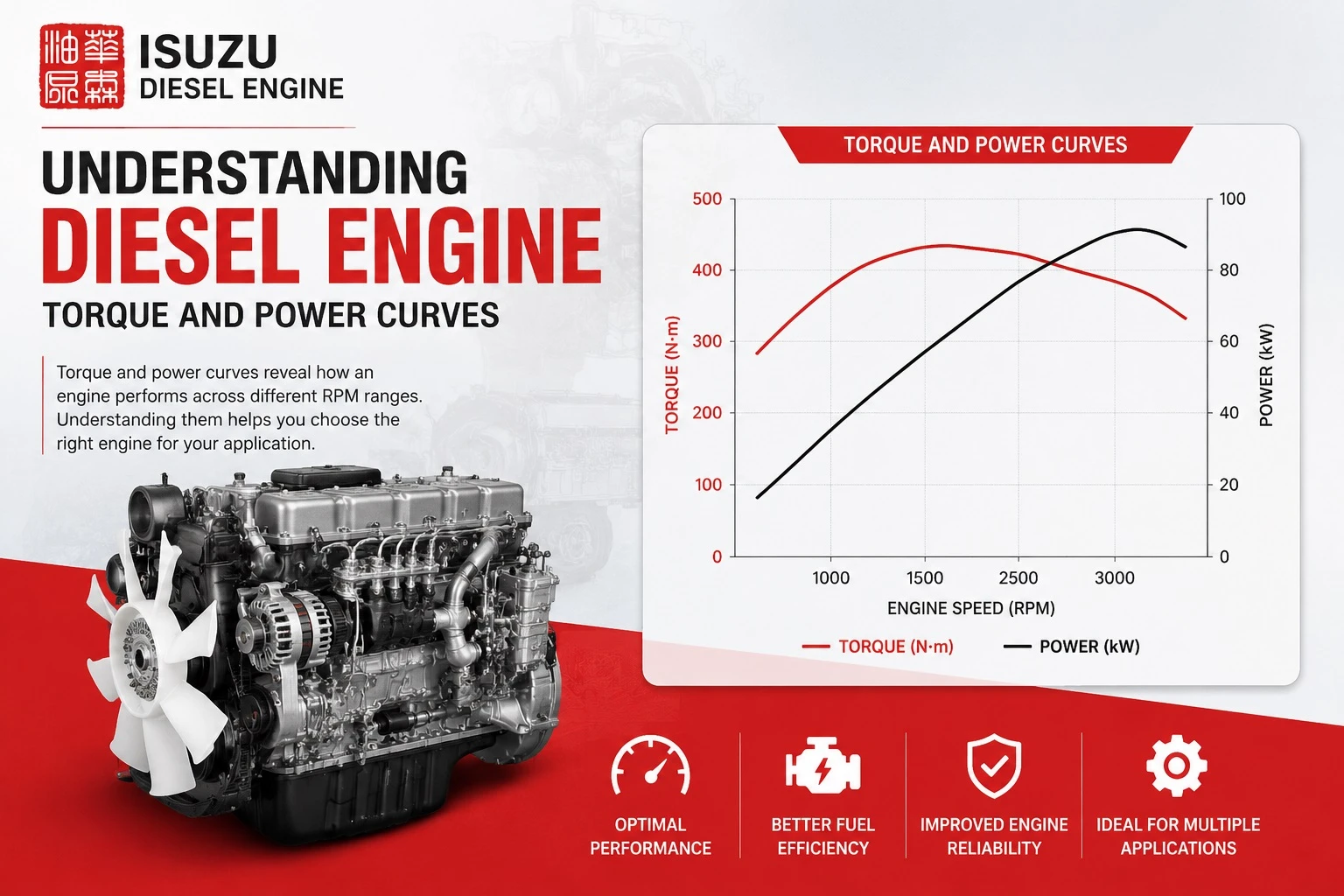
A torque curve displays peak pulling power produced at different speeds per minute (RPMs). Torque peaks early for most diesels (typically 1200-1800 RPM) and remains level at a broad range. This is a characteristic of a good-quality diesel engine design.
The power curve, on the other hand, continues to rise as RPM increases. This is because power is a function of torque and speed. As torque begins to decrease, RPM might still produce more power, at least for a short time.
For applications that require continuous, sustained power (such as towing, pumping, or lifting), you want a high peak torque, high torque band diesel engine. When high speed and lots of output are required, a diesel engine must have a considerable amount of peak power at high r.p.m. Many B2B buyers require both. That's where hiring a reliable diesel engine company becomes vital – a company that can assist you in matching engine specs with your actual workload.
Not all diesel engines are built the same. There are some factors that impact the shape of a real-world diesel engine torque and power curve:
Fuel injection system: Modern common-rail direct injection systems benefit the transmission of torque and efficiency.
Turbocharging: A turbocharged diesel engine can deliver significantly more torque and power once boost pressure builds up in the mid-RPM range. Note that at very low RPM, turbo lag may reduce the initial torque response before boost comes on.
The size of the engine: Larger engines will create more torque, particularly at low revs.
Higher compression ratios also increase combustion efficiency and provide increased power and fuel economy.
Cooling system: A good cooling system keeps diesel engines performing at their best for long periods of time.
Understanding these factors helps B2B buyers ask the right questions when evaluating diesel engines from suppliers.
The selection of the appropriate diesel engine depends on matching the engine's performance attributes to the particular requirements of the operation. To get a bit of a framework:
Determine the load — what is the largest load that the engine will encounter?
Determine operating RPM range — Can the engine be operated in a steady, low RPM range or a variable, high RPM range?
Examine torque and power curves – Not just the numbers, but look at peak values and the operating band.
Emissions standards — Make sure the diesel engine meets local regulations of your industry.
Compare TCO — Take into account fuel usage, maintenance periods, and parts availability.
Learning about torque and power curves isn't just about the technical details; it's also a business benefit. These performance indicators can guide your selection of diesel engines that meet your operational requirements, helping you to ensure efficiency and productivity. Choosing the right engine specifications can lead to fuel savings as well as maintenance cost and equipment life savings. When engine specs are matched to actual workload, the engine runs within its optimal torque band — reducing strain, cutting fuel consumption, and extending service intervals. This results in reduced downtime and increased ROI. Selecting the right diesel engine is essential for everything from generators to construction machinery, marine applications, or industrial equipment. 4tnvengine (XiaMenJin HuaSen Propulsion System) provides you with reliable and high-performance engine solutions that are supported by technical knowledge in determining the best engine for your business.
Torque is the force that the engine can exert; horsepower is the rate at which the engine can exert that force. The advantage of a diesel engine is that it produces a lot of torque at low RPM.
Direct fuel injection and higher compression ratios enable diesel engines to deliver more power per power cycle and better low-RPM torque figures.
For heavy-duty applications, most diesel engines will generate the highest amount of torque at the 1,200 to 2,000 RPM mark.
A turbocharger will provide more airflow into the engine, which will improve combustion efficiency and increase torque and power throughout the RPM range.

I’m a positive and ambitious person who enjoys learning new things, meeting people, and growing through every experience. I value honesty, confidence, and keeping a balanced outlook in life.
Corner damage is one of those problems that seems minor until it isn't. A dented plaster edge here,
29 August 2026
Buying large quantities of SMT-equipped feeders is distinct from purchasing only a few spares. If yo
12 August 2026
Hot tapping services in Rak are used when a connection needs to be added to an existing pipeline wit
24 July 2026
Be the first to share your thoughts
No comments yet. Be the first to comment!
Share your thoughts and join the discussion below.